
Understanding Baby Sleep at 4–7 Weeks: Awake Windows, Rhythms, and Realistic Expectations
If the first few weeks with your newborn felt sleepy and slow, weeks four through seven can feel like a sudden shift. Babies become more alert, more curious, and sometimes more vocal about their needs. Many parents are surprised to find that sleep feels harder during this phase, not easier.
Understanding what’s happening biologically during weeks four through seven can help families feel less caught off guard. Sleep challenges during this stage are not a sign that something is wrong. They’re a normal part of development as babies begin to wake up to the world around them.

Sleep Cycles Are Still Short, But Awake Time Is Growing
Even at four to seven weeks, babies still move through shorter sleep cycles than adults. They spend more time in light sleep, which makes them easier to wake and more sensitive to changes in their environment.
What does change during this stage is awake time. Many babies can comfortably stay awake for 60–75 minutes before becoming overtired. This window includes feeding, diaper changes, brief play, and connection. When babies stay awake much longer than this, sleep can actually become more disrupted rather than more consolidated.
Encouraging wakefulness after feeds during the day helps babies begin to separate day and night, even though their internal clocks are still developing.
Circadian Rhythms Are Forming, Not Finished
By weeks four through seven, babies are slowly starting to recognize patterns in their day, but their circadian rhythms are far from mature. Night wakings remain normal, and longer stretches of nighttime sleep may appear inconsistently.
Daytime light exposure, gentle play, and predictable rhythms help support this transition. At night, keeping feeds calm, quiet, and low-stimulation sends a subtle signal that nighttime is for resting, not playing. This stage is about repetition, not perfection.
What a Gentle Daytime Rhythm Can Look Like
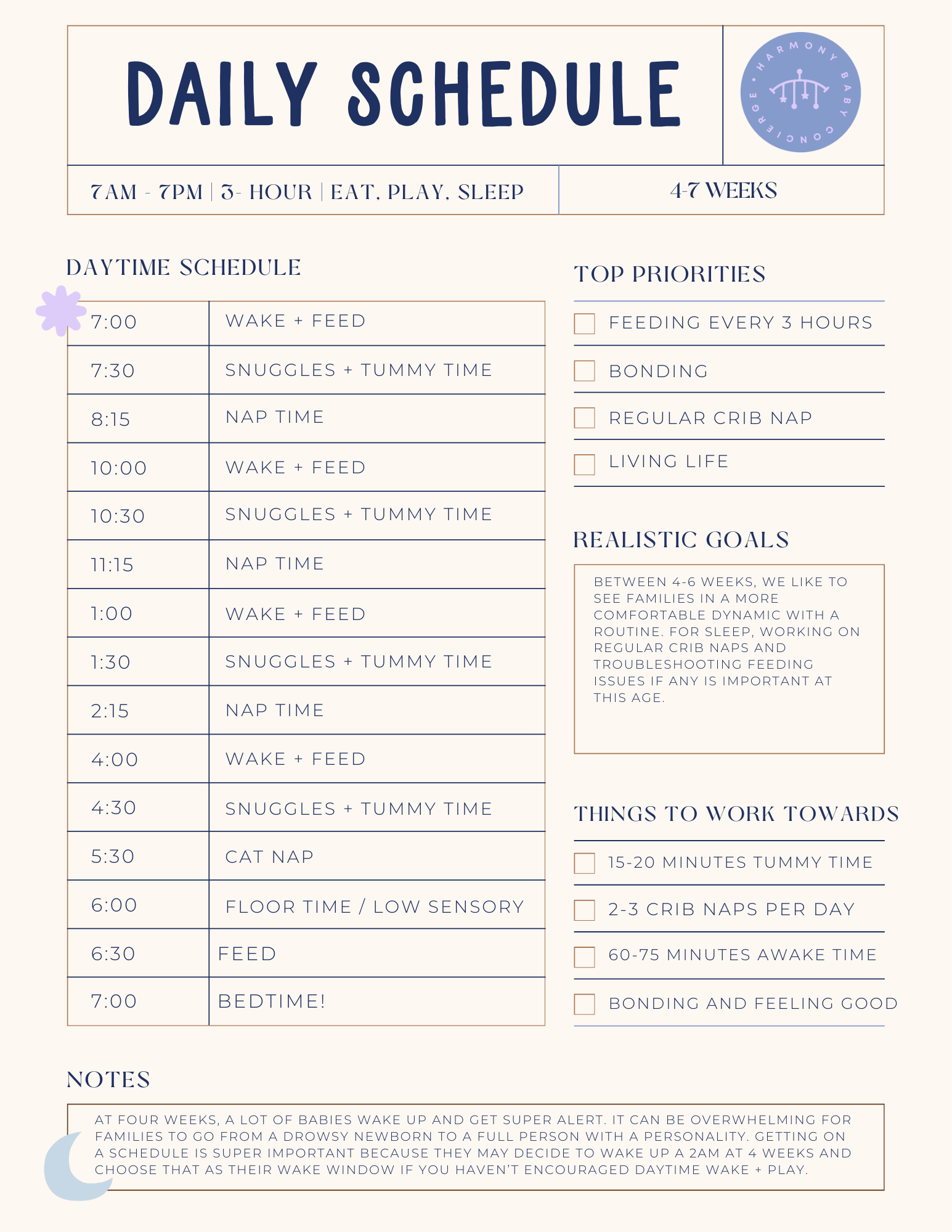
Here at Harmony, we often support families through a gentle three-hour Eat, Play, Sleep rhythm during weeks four through seven. Days typically begin in the early morning and wind down by early evening, with babies feeding about every three hours and enjoying short, meaningful moments of connection before rest.

Awake time may include snuggles, tummy time, or calm floor play, followed by naps that begin before little ones become overtired. Some naps happen in the crib, while others still occur on the go, and both are completely appropriate at this stage of development.
Late afternoons can feel trickier. A short cat nap, followed by low-sensory floor time and a calm feed before bedtime, often helps babies settle into the evening more smoothly.
What to Prioritize at This Stage
Rather than chasing long stretches of sleep, weeks four through seven are best used to gently support consistency. Helpful priorities include regular daytime feeds, bonding, and practicing crib naps when possible.
This is also a time to address feeding challenges if they arise and to help babies learn that daytime is for being awake and engaged. Many babies “wake up” around four weeks, and that increased alertness can feel overwhelming if families aren’t expecting it. Supporting daytime wakefulness often leads to more settled nights over time.
Realistic Goals for Weeks 4–7
Progress during this phase is gradual. Healthy goals often include:
Working toward 15–20 minutes of tummy time spread throughout the day
Practicing 2–3 crib naps per day
Supporting 60–75 minute awake windows
Strengthening bonding and confidence as a family
Sleep may still feel inconsistent, and that’s okay. Foundations are forming even when it doesn’t feel obvious.
A Reassuring Note for Parents
Around four weeks, many parents notice their baby feels like a “full person” overnight. This shift can be joyful, exhausting, and emotional all at once. Establishing a gentle rhythm during the day becomes especially important because babies may choose unexpected nighttime hours as their most alert window if daytime wakefulness isn’t encouraged.
This phase isn’t a regression. It’s growth.
How Harmony Baby Concierge Can Help
Support during weeks four through seven can make a meaningful difference. Harmony Baby Concierge’s newborn care specialists, night nurses, and postpartum doulas help families understand sleep cues, establish gentle routines, and adjust expectations during this transition. With experienced guidance, parents can feel more confident, more rested, and more supported as their baby grows.
Harmony Baby Concierge is a full service Newborn Care + Postpartum Support Agency based in Dallas, Austin and Houston, Texas. We have a well-rounded team of Newborn Care Specialists, Night Nurses, Postpartum Doulas, Newborn Night Nannies and Baby Nurses. We provide lactation support, newborn care, night nursing, gentle sleep training and parent education to families of newborns. We serve all families with love, warmth and care. Serving: Dallas, Austin, Houston, Highland Park, University Park, Kessler Park, Lake Highlands, Lakewood, Plano, Frisco, Celina, Prosper, Fort Worth, Southlake, Westlake, Irving, Preston Hollow, Park Cities, Grand Prairie, Carrollton, Houston, Manvel, Galveston, West University, Austin, Barton Creek, Round Rock, Houston, Denver, New York City, Greenwich CT, Manhattan, Brooklyn, Englewood Colorado, Cherry Hills Village CO, and Surrounding Areas.